#include <eoOneMax.h>
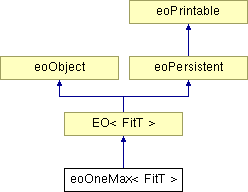
Inheritance diagram for eoOneMax< FitT >:
Public Member Functions | |
| eoOneMax () | |
| Ctor: you MUST provide a default ctor. | |
| virtual string | className () const |
| Return the class id. | |
| void | printOn (ostream &_os) const |
| printing... | |
| void | readFrom (istream &_is) |
| reading... | |
| void | setB (vector< bool > &_b) |
| const vector< bool > & | B () |
Private Attributes | |
| std::vector< bool > | b |
Note that you MUST derive your structure from EO<fitT> but you MAY use some other already prepared class in the hierarchy like eoVector for instance, if you handle a vector of something....
If you create a structure from scratch, the only thing you need to provide are a default constructor IO routines printOn and readFrom
Note that operator<< and operator>> are defined at EO level using these routines
Definition at line 31 of file eoOneMax.h.
|
|||||||||
|
Ctor: you MUST provide a default ctor. though such individuals will generally be processed by some eoInit object Definition at line 37 of file eoOneMax.h. |
|
||||||||||
|
Return the class id.
Reimplemented from EO< FitT >. Definition at line 49 of file eoOneMax.h. |
|
||||||||||
|
printing... HINTS in EO we systematically write the sizes of things before the things so readFrom is easier to code (see below) Definition at line 52 of file eoOneMax.h. References EO< F >::printOn(). |
|
||||||||||
|
reading... of course, your readFrom must be able to read what printOn writes!!! HINTS remember the eoOneMax object will come from the default ctor this is why having the sizes written out is useful Definition at line 72 of file eoOneMax.h. References EO< F >::readFrom(). |
 1.3.9.1