
83 lines
3 KiB
Markdown
83 lines
3 KiB
Markdown
Educational demonstration of several design patterns which may be useful in algorithmics, in several languages.
|
|
|
|
The algorithms are simple motion planning methods
|
|
and the patterns are centered on composition.
|
|
The code demonstrates how to *compose* either a Dijkstra algorithm,
|
|
either a fast-marching algorithm, with different neighborhoods for each.
|
|
|
|
|
|
Avalaible languages
|
|
===================
|
|
|
|
So far, the demo contains:
|
|
- Python:
|
|
- a purely functional pattern (functions which returns parametrized closures),
|
|
- the strategy pattern (composition of abstract interface),
|
|
- C++:
|
|
- purely functional (functions which returns parametrized lambdas),
|
|
- strategy (composition of abstract classes),
|
|
- policies (function parameters as templated variables),
|
|
- CRTP (Curiously Recurring Template Pattern).
|
|
- Java:
|
|
- functional,
|
|
- strategy,
|
|
- CRTP.
|
|
|
|
The algorithm machinery itself is located within the `code.*` files
|
|
and is not of major interest,
|
|
look for the other files for the architecture.
|
|
|
|
|
|
Algorithmics
|
|
============
|
|
|
|
The Dijkstra algorithm is a well-known way to compute shortest paths on a graph.
|
|
Here, we use a simple regular discretization of a bounded plan as the
|
|
navigation domain (i.e. a grid).
|
|
The Dijkstra algorithm proceed by going on the edge from one node of the graph
|
|
to another *neighbor* node (in a specific order, which does not matter here).
|
|
As such, it needs to know what is the neighborhood of a node.
|
|
Here, we define two choices: either a set of four nodes, or a set of eight
|
|
nodes.
|
|
|
|
The Fast-Marching algorithm is a generalization of the Dijkstra's algorithm
|
|
for continuous space instead of a graph.
|
|
Instead of going from one node to another, it will traverse a triangle
|
|
(i.e. one of the 2D *simplex* of a partition of the domain space),
|
|
from one node to the opposite edge.
|
|
The difference between the two thus rely on how they define a *transit* on the domain.
|
|
This traversal is called the *Hopf-Lax operator* in the litterature.
|
|
|
|
Just like Dijkstra needs to know how many nodes are in the neighborhood,
|
|
Fast-Marching needs to know how many triangles are in the neighborhood.
|
|
|
|
|
|
Architecture
|
|
============
|
|
|
|
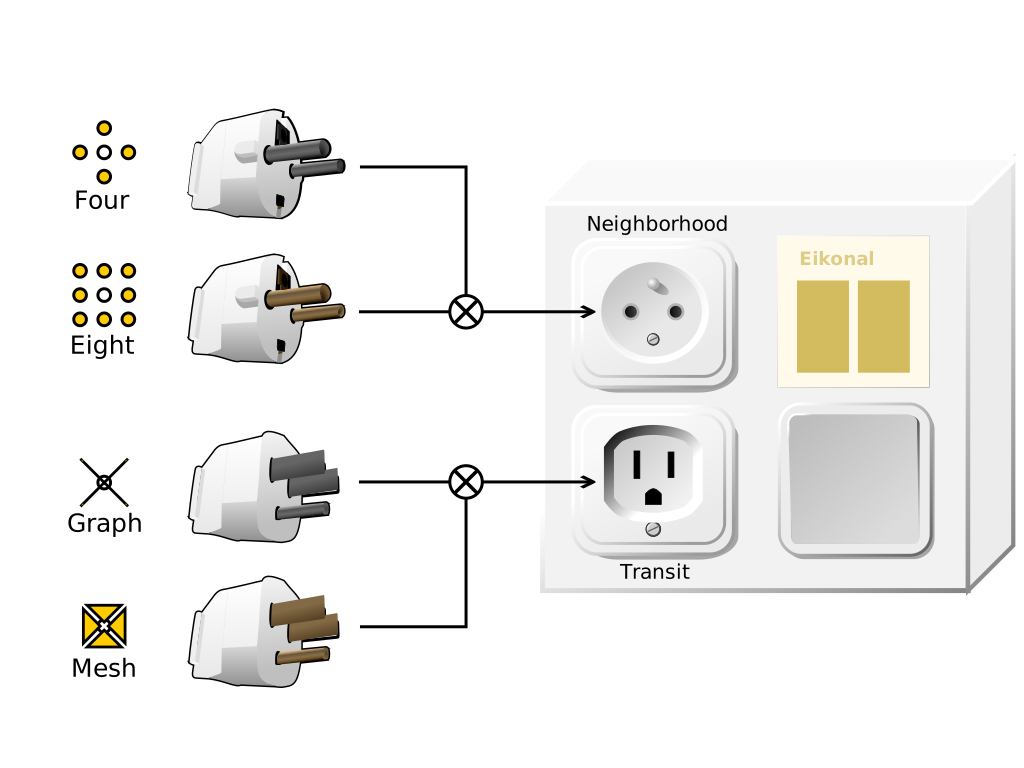
Hence, we have two *operator slots* for each algorithms:
|
|
- neighborhood (where to go?),
|
|
- Hopf-Lax operator (how to go there?).
|
|
|
|
For each slot, we have two options:
|
|
- neighborhood:
|
|
- four neighbors,
|
|
- eight neighbors;
|
|
- Hopf-Lax:
|
|
- on the edge of a graph,
|
|
- across a triangle.
|
|
|
|
|
|
|
|
At the end, by combining those options, we can make up for four different
|
|
algorithms:
|
|
- four neighbors + on edges (4-Dijkstra),
|
|
- eight neighbors + on edges (8-Dijkstra),
|
|
- four neighbors + in triangles (4-Fast-Marching),
|
|
- eight neighbors + in triangles (8-Fast-Marching).
|
|
|
|
Each of those algorithms may have different behavior/performances and be useful
|
|
in different cases.
|
|
It can however be handy to easily come up with the one you want,
|
|
especially if you have many more operators to manage.
|
|
|